
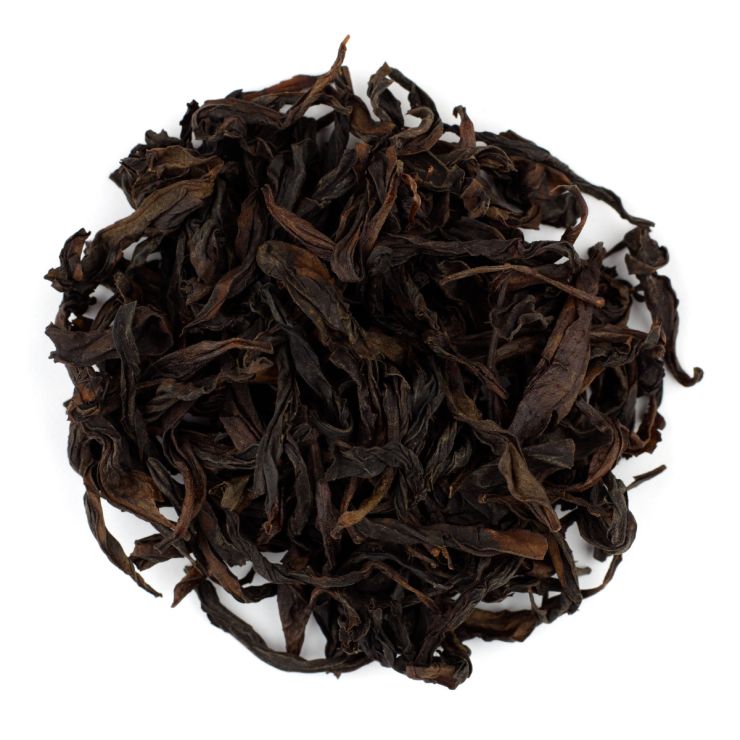
Yu Hua Feng Rou Gui (2025)
This Rou Gui is from the 2025 harvest. The tea is a so-called Wuyi Mountain rock tea i.e. slightly darker roasted wulong tea from the Wuyi Mountains in northern Fujian. The tea is from the central area of the Wuyi Mountains, whose tea gardens are considered by many experts to be the best. The tea has grown on a hill near the Yu Hua Cave. The tea represents excellent quality in its own category. The dry tea has a deep, fresh, dry spicy and fresh fruity aroma. The taste is robust. It has a slightly coniferous character, dry spiciness and apricot-like fruitiness that continues into the long aftertaste.
Details
General
In China, it is sometimes said that the best teas are produced in the most famous mountains. There is certainly no clearer example of this wisdom than the legendary Wuyi Mountains in Fujian Province, China. The Wuyi Mountains, with their dense forests surrounding a winding river and their limestone peaks rising towards the clouds, are like a view of the Chinese soul. For centuries, this landscape has attracted ascetics, scholars and monks who have sought out Wuyi for its invigorating effects on mind and body. The rocky terrain of the region, surrounded by mist and fed by fresh mountain streams, is home to tea trees whose growing conditions cannot be imitated anywhere else.
The Wuyi Mountains' wulong tea is called rock tea. Although there are several different varieties of tea trees, the way the leaves are processed is essentially the same for all different types of rock tea. Only fully grown leaves are picked from the tea bushes. First, the leaves are allowed to release some of their moisture by spreading them on large round bamboo platforms that are exposed to sunlight. The leaves are then mechanically processed to break down the cell structure of the leaves and accelerate oxidation. This is repeated a few times, allowing the leaves to rest between processing. When the moisture and oxidation of the leaves have progressed sufficiently, the tea is mechanically rolled to release the flavors and create an elongated rolled shape. Finally, the leaves are roasted until dry. Roasting is traditionally done over hot coals on a large bamboo platform. Roasting locks the leaves in their shape and darkens the color and flavor of the leaves. The degree of oxidation of the tea leaves is typically around 30-60%. The color of the leaves before roasting is dark green and in places slightly brown. The strength of the roast determines the color and taste of the brewed tea. The roast can be light, in which case the color of the tea liquid is yellowish, medium, in which case the color is yellowish-orange, or strong, in which case the color is brownish-red.
Rou Gui tea bush variety has only become widespread in the last few decades and has achieved a position alongside the four traditional tea bush varieties of the Wuyi Mountains - Da Hong Pao, Bai Ji Guan, Tie Luo Han and Shui Jin Gui. The name Rou Gui refers to the cassia tree, from whose bark the commonly available spice cinnamon is made. The tea itself has nothing to do with cassia cinnamon, but the aroma of the tea is said to resemble the spicy, pungent scent of cassia cinnamon bark.
This tea
This Rou Gui is from a 2025 harvest. The tea is from the central area of the Wuyi Mountains, where many experts consider the tea gardens to be the best. The exact place where the bushes grow is the Yu Hua Feng at the beginning of the name, which refers to the peak near the Yu Hua Cave. The tea is picked from the bushes of the Rou Gui variety, which is very popular for its complex and rich flavor.
Taste
The dry tea has a deep, fresh dry spicy and fresh fruity aroma. In the cup, the aroma is a delicious combination of dry woody roastiness and sweet dried fruit. The taste is robust. It has a slightly piney character, dry spiciness and apricot-like fruitiness that lasts for a long time.
Infusion
Use boiling water to brew the tea. Wuyi mountain rock teas are traditionally brewed using the gongfu method, i.e. by infusing the leaves in a small teapot (0-300ml) several times so that the steeping times are short. The amount of leaves used in this method is about 1/3 of the teapot. The steeping time is about 10-30 seconds. A shorter steeping can also be good, but a much longer steeping rarely is. The length of the steeping can be extended with subsequent infusions.
If you are using a larger teapot and brewing no more than 2-3 times, the amount of tea leaves is 4-5g, i.e. a heaping tablespoon. The brewing time in a larger pot is 3-5 minutes. The leaves can normally be brewed more than once.
- Country of manufacture: China
- Ingredients: Tea
- Importer: Teepolku Oy
- Business registration number: 2484659-6
- Store in a dry place, not above normal room temperature