
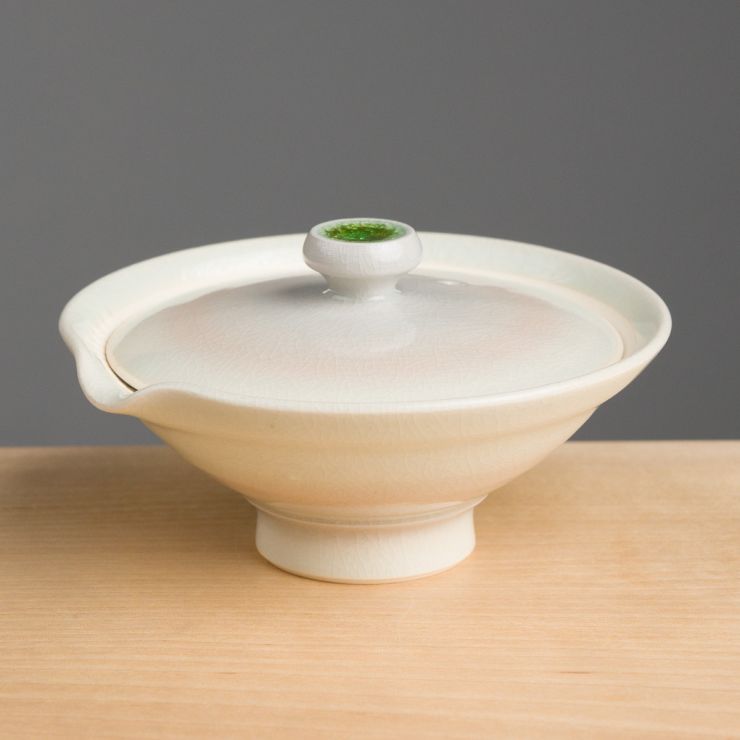
Shiboridashi #1 Asamoya, Sawahoyama (80ml) Shigaraki-yaki
Sawa Hozan (born Sawa Harumi) is a second-generation Shigaraki ceramicist at the Sawahoyama studio, located in the city of Koka, Shiga Prefecture. The studio was founded by Hozan’s father, who moved to Shiga from Kyoto. Hozan runs the studio alongside his son, Masayoshi. The shiboridashi is a type of shallow teapot designed to allow the water to cool quickly; the strainer is formed by grooves at the base of the vessel working in conjunction with the lid. Shiboridashi teapots are used to brew high-quality Japanese green teas, such as kabusecha and gyokuro, which are often best prepared at lower temperatures. This particular piece features an Asamoya ("morning mist") glaze, with pale, slightly peach-toned hues that evoke the image of a sunrise breaking through the mist. The vessel’s crackle glaze pattern becomes more pronounced with use, and the knob on the lid is accented with a translucent emerald-green glaze.
Details
Basic Information
Ceramicist: Sawa Hozan (born Sawa Haruki) 澤晴己, Studio: Sawahoyama 澤鳳山
Teapot capacity: 80 ml
Ceramicist's certificate: No
Strainer type: Grooves on the side
Ceramic type: Shigaraki-yaki 信楽焼
Teepolku's Comments
Sawa Hozan (born Sawa Haruki) is a second-generation Shigaraki ceramicist at the Sawahoyama studio. The studio operates in the city of Koka, Shiga Prefecture. The Sawahoyama studio was founded by Hozan's father, who moved to Shiga from Kyoto. Hozan runs the studio together with his son, Masayoshi. The shiboridashi is a low-profile teapot design that allows the water to cool quickly. The strainer is formed by grooves at the base of the vessel working in conjunction with the lid. Shiboridashi teapots are used for brewing high-quality Japanese green teas, such as kabusecha and gyokuro, which often require lower brewing temperatures. This shiboridashi features an Asamoya (morning mist) glaze; its light, slightly peach-toned hues evoke the image of a sunrise seen through the mist. The vessel's crackle glaze pattern becomes more pronounced with use. The knob on the lid is decorated with a translucent emerald-green glaze.