
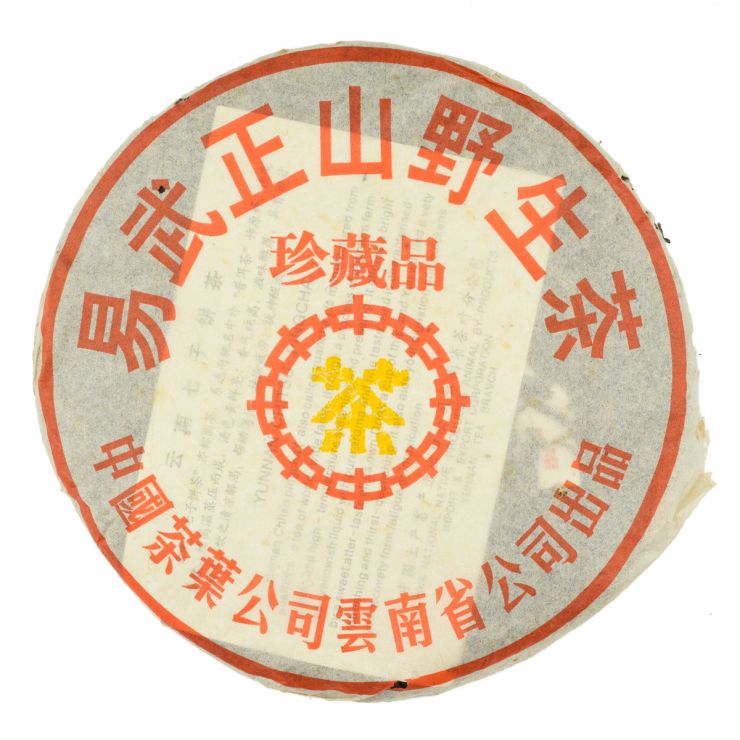
Huang Yin - Yiwu Zheng Shan Ye Sheng Cha ~ 2010, Sheng Pu'er
This sheng pu'er is packed in the style of state-owned pu'er production. The paper wrap is decorated with so-called Yellow Mark. We do not know the exact age of this tea, but we estimate that the tea was produced around 2010. The name of the tea is the Main Mountain Wild Tea of Yiwu. The dry tea has a nice spicy and fresh aroma. In the cup, the aroma is slightly spicy and apricot-like, unlike the typical Yiwu grassiness. The taste is bright with fruits and spices.
Details
General
Yiwu Tea Production Area is one of the most important pu'er tea production areas in Yunnan. The area has about 10 square kilometers of land under tea production. The hight in this area varies from 800 to 2000 meters. The name Yiwu refers to both the entire mountain range and the village in the area. Although often referred to as Yiwu Mountain, the area is actually a mountainous area with several peaks and villages, whose tea is often referred to by their own names. The most important villages are, in addition to the central village of Yiwu, Mahei, Luo Shui Dong and Man Xiu. These are mainly inhabited by the Han Chinese, the most common ethnic group in China. The Han Chinese arrived in Yiwu at the end of the Qing Dynasty and started tea production as a business. At that time, tea had already been produced in Yiwu for several hundred years by the local Bulang minority. The outer villages are more difficult to reach and are inhabited by smaller ethnic groups in China. Such villages include Ding Jia Zhai and Gua Feng Zhai. The tea from the different villages in Yiwu has a soft, hearty taste, stunning taste and activity in the mouth. Yiwu tea is valued because of these characteristics.
This tea
This sheng pu'er is produced under the branding of the state-owned Pu'er production at the time. This is what the so-called Ba Zhong -logo in the middle of the paper informs. The style of the paper is so-called Huang Yin or Yellow Mark, which refers to the printing and style in the wrap. There is no information on the exact age of the tea, but in our opinion it seems to have been produced around 2010. At this time, the production of pu'er tea has been almost entirely in private hands, so this tea is probably not produced by the state. These Ba Zhong-style pu'er products are produced in private tea factories under license from the government agency that owns the rights to use the style. These types of tea have been produced in large quantities even in the 21st century and the quality of these products varies wildly. In addition to the national style, this tea also has the additional name Yiwu Zheng Shan Ye Sheng Cha, i.e. Main Mountain Wild Tea of Yiwu.
Taste
Dry tea has a nice, spicy and fresh scent. In the bowl, the aroma is slightly spicy and apricot-like, different from the typical hayiness of Yiwu. The taste is bright, fruity and spicy.
Infusion
Use a sharp tool to remove the leaves from the pressed tea for brewing. You can use, for example, a kitchen knife. A spike-like shape works best, as it breaks the leaves less. Pu'er tea is brewed with boiled water. About 4-6 grams of leaves are needed, or a generous tablespoon of loose tea. The tea leaves are rinsed first. Hot water is poured over the tea leaves and allowed to brew for about 10 seconds. The rinsing water is poured off. This rinsing helps to make the tea clear and reduces the stronger fermentation taste and smell on the surface of the leaves. The tea can be brewed in a so-called gongfu technique, using a teapot of less than 300ml and steeping the leaves several times. In this case, the length of the steeping should be about 30-60 seconds. The amount of leaves can also be increased, in which case the steeping time can be reduced to 10-20 seconds. If you are using a larger teapot or want to make only one steeping, the steeping time should be 3-5 minutes. Adjust the amount of leaves to achieve the desired strength.
- Country of manufacture: China
- Ingredients: Tea
- Importer: Teepolku Oy
- Business ID: 2484659-6
- Store dry and at room temperature